My favourite part of writing is, unsurprisingly, writing. Dissecting scenes, shaping the grand form of the drama. It’s joyous. I get so wrapped up in the nitty gritty of the story that reading the script back afterwards is always, universally… depressing.
There’s always something missing. It’s sometimes an insight or a detail that doesn’t ring true, but more often than not the script just feels hollow. Of course, hindsight is 20/20, so I always know the reason it feels hollow is a lack of research and topic authority, but that doesn’t stop me barrelling into the next story script-first, making the same mistake over and over again.
For Factions, however, I’ve vowed to change that. There will be no stone unturned, no lack of insight, and no weak arguments.
Factions will be researched.
So that’s what I’ve spent the last month doing. I know the broad strokes of the story. I know the barest information about the characters and their journeys. I know the tone and vibe I want to achieve with the finished script. Despite that, I know nothing.
Nature
There’s a deep connection to the natural world I want to thread through Factions, but my horticultural knowledge stretches about as far as a windowsill herb garden, if that. So, rather than spend my days scrolling Google searches to give the allusion of knowledge, I bought a book. Return to my Trees isn’t an educational novel, it’s a travel memoir. It holds more than just the names and origins of woodlands and the species within them. It holds valuable historic tales, perspective, and insight that won’t be found in any blog post.
So, from 1st May I sat at my dining room table, notebook and sticky tabs at the ready, and got to reading. So much of the material fascinated me. The journey of the book, much like the fictional one my characters will go on, started in Cardiff. Serendipity. As I read, whole scenes of my future script poured out of my head. In fact, a whole episode has now moved to Wentwood forest purely so I can have scenes set up Gray Hill. It’s a horrendous detour on the questers direct route, but being able to showcase that natural beauty is not only an opportunity too good to miss, it’s slowly becoming an intrinsic need of one of my characters.
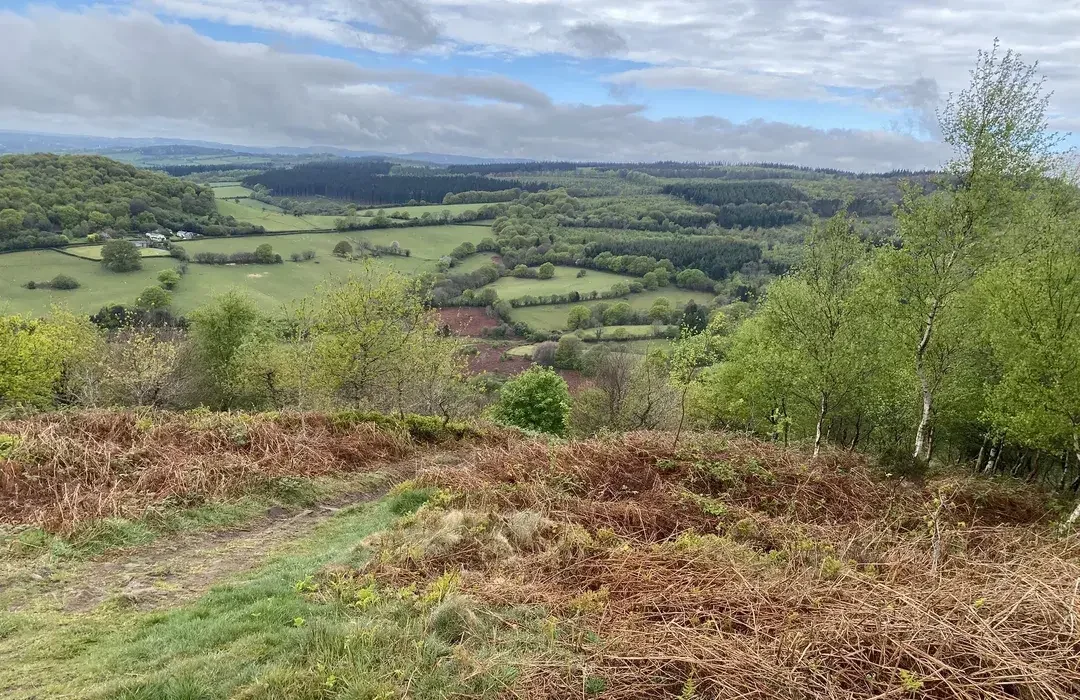
View from Gray Hill
But more than location, Return to my Trees is also teaching me valuable words in the Welsh language. Of course, Google translate can (butcher) translate whatever I need when it comes to writing the script, but real language is in the idiosyncrasies that an online translation software won't see. The way Welsh forests and wild lands got their names are as important as what they’re actually called, especially when trying to invent a pseudo-realistic post apocalypse.
Maybe the most surprising thing I got from researching via Return to my Trees was in reading about the druids of ancient Wales. While interesting and educational, I found myself needing to implement druidic lifestyle habits throughout my first episode. It was the missing piece of a puzzle I didn’t realise I was doing. Once put in place, ideas for characters, motivations, and relationships seemed to spark endlessly.
Of course, this one small book isn’t all the research I’m doing on Welsh life, language, and nature, but it’s proved a far more insightful jumping off point than a video essay or Google search would have ever been.
Welsh Myth and Legend
On the scale of the whole series, the story’s time in Wales is relatively thin. However, when it is there I want the series to feel like it’s fully there. Beyond the geography, this is a version of Cardiff and Wales that is deeply entrenched in an idealised version of its history.
To warn children of the dangers that exist beyond their commune walls, parents tell tales of the traveller-devouring Gwillgi. To keep the populous from travel, tales of the venomous gwiver ensure people avoid crossing rivers.
It’s a small element of one episode, but by tying it back to theme, it becomes just as crucial as any other element.
Post-Apocalypse Medicine
Given the close connection to nature, and the fact that the quest of my protagonists will be long, arduous, and dangerous, medicine is an incredibly important element of the world I’ll be creating. Having spent a whopping £2 (I had leftover Christmas vouchers) on Return to my Trees, I decided to follow more conventional, blog-based research avenues for hints and tips on natural remedies.
What I didn’t expect to find is the kernel of an idea for a scene that gets to the heart of my protagonists issues via dandelion root coffee. Yet here we are. Getting a broad education in natural remedies for common injuries and ailments is going to be vital for when I come up against scenes where characters need medical attention. It also gives me the opportunity to consider how that knowledge can be woven into the characters. It’s not just a case of knowing how to bandage an injury with plantain leaves, it’s knowing why a character has and needs that information.
As a result of this research, I not only have a comprehensive list of balms and ointments for all occasions, I have scenes, drama, and characters with more depth and nuance than I could have ever achieved without it.
Empire
The main antagonist of Factions is heavily inspired by the practices and dogma of the British Empire. Their effort to ‘reunify the kingdom’ is heavily influenced by colonial tactics. But again, beyond a high school education, I knew little of how the British actually implemented their colonial practices. The BBC documentary series ‘Empire with David Olusoga’ changed that. In my world, the redcoats are at the very start of their reunification journey, so this documentaries focus on the birth of the Empire was focused perfectly for my needs.
The one thing I knew I needed was a focus on how colonisation happened, and one interview with a Native American historian gave me the exact insight I needed. We are often taught of abstract bargains and betrayals, but the documentary was able to offer insight into the wants and needs of both sides in a way that will heavily influence the writing of my whole series. Ironically for a series called Factions, I’d almost forgotten that factional warfare is often the easiest tool in an invading army’s arsenal.
Given that the antagonists worship the idea of the British Empire, this documentary also gave me a whole roster of individuals that can be used as naming inspiration for the commanders, politicians, and incidental villains of the piece.
One insight I wasn’t expecting, may not use, but am incredibly grateful to know, is how slavery was introduced to the empire once it was established. The use of indentured labourers wasn’t something I’d considered, but it is an interesting wrinkle or plot point that can be added later in the story if necessary.
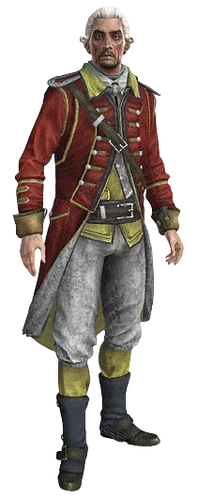
Example of Uniform from Assassin’s Creed - Black Flag
Army
Given the militaristic nature of the antagonists, the Red Coats need to feel believable. This was the first time I turned to old fashioned YouTube research (when did that become old fashioned?) to find the information I needed.
While I have no intention of using and implementing every rank and uniform in this fictional army, I know that I’ll need to call on that knowledge quickly when it comes up. So, I watched a documentary on the lifetime of the uniform of the British army. In my world, I need to know what a Red Coat will wear, what it’s made from, how the dye is sourced, what that looks like, and how scarcity of material is used to denote rank. Then I need to know what the ranks are. The documentary’s insight into how colour of undergarment, accessories, and more to denote class and rank will be vital information to capitalise on when it comes to actually creating this sort-of made up army.
Beyond the documentary, I used several military websites and sources to explore military ranks and uniforms through the ages. What I now have, when mixing this research with similar work done on Empire building, is a clear idea of how my version of the Red Coats operate, with archetypes that can one day become compelling characters. No longer is the story “redcoats vs factions”, it’s “Reunify Battlegroup West Two, under the command of Brigadier Smith vs the Welsh speaking druids of Cardiff Castle”… far more compelling.
As almost all the ‘antagonists’ the audience will meet on this journey will be from this new / old British military, I needed to be sure they have a distinct voice. That led me down a rabbit hole of military slang which was insightful, and often hilarious. So much of it makes no sense, which is great fodder for making a new, theme and narrative specific inspired version of military slang for Factions.
Politics
The main antagonist of the series is a self-proclaimed Prime Minister of this disunited Kingdom. Unfortunately, I know little of how the British political establishment is set up. I wanted to find a simple cabinet construction that would be emblematic of the cabinets current construction, while also harking back to the famous cabinets of wartime Britain etc. The ‘Prime Minister’ is literally called William Churchill (or is he?) so some semblance of historical iconography is massively important.
What I found was the crippling sense that our political system is actually doomed to fail relatively soon. I was able to fill almost two FULL PAGES of my notebook with the individual members of the current cabinet. And some of them are doing multiple roles! While it’s infuriatingly incompetent irl, it’s actually a stroke of narrative gold for me, as it provides context and motive to Will Churchill to create a new/old kind of cabinet to reunify the UK under his rule.
The political system of Factions will certainly look like the system we know from our real world, but like most fledgling dictatorships, the whole system will centre around the elevation and godhood of its central figure. This is a world where British politics and cult of personality have made a bed together… you know, completely unlike the modern world we’re living in.
Conclusion - I’m not Done
Irritatingly, there’s so much more I wanted to research before moving on to the next step of writing Factions. I spent a weekend pottering around in Assassin’s Creed, getting an idea of what free running looks like so I can convincingly write the movements of my protagonist, but never got beyond a bit of running around. Similarly, I wanted to spend more time reading Return to my Trees, but only got about half way through. I wanted to make a ‘vibes’ playlist on Spotify, and read the screenplays to The Lord of the Rings to get an idea of how Peter Jackson responded to the scale on the page.
So much didn’t get done.
But so much did.
Before May began, I had no real idea of British military or political structure beyond what was seen on the news and at the military tattoo. Welsh wildlife was something I simply walked next to on my way to work in the morning. Welsh myths and legends were just book covers.
The point of this prolonged challenge is to get a full, realised, and hopefully competition-ready draft of Faction’s first episode by the date of the BBC’s annual open call. If nothing else, I’m absolutely ready to move on to the next step of that journey.
Across June (and maybe July - this month is WILDLY busy) I’ll be working on outlining the series as a whole, with particular focus on the first and final episodes. I’m also super excited to start working on the series bible. Even after all this research, I’m still engaged and excited by this material, and as the world devolves around us it only adds fuel to my fire.
To keep up to date with the writing challenge, follow me on Instagram at @tongueincheekwriter