Narrative Structure is Dead. Long Live Narrative Structure
Like most fledgling writers, I’m obsessed with the scriptwriting podcast Scriptnotes. There’s a point that routinely gets hammered home on the pod that, for a while, I was incredibly resistant to. They hate structure. But, the more I’ve read, and the more I’ve written, I’ve come to realise they’re absolutely right. Narrative structure in screenwriting is utter codswallop, and yet without it this industry is nothing.
Strange dichotomy isn’t it? Let’s explore that.
The Differing Approaches
Good lord there’s a lot of structures out there. Three acts. Four Acts. Five Acts. The Hero’s Journey. Story circles. Mid-point reversals. Seven Basic Plots. To new, fledgling, and studying writers, they’re an infallible safety blanket. If you’re struggling in the second act, just look to what Christopher Booker says should happen now in all good quest stories. Don’t know how to end your story? The Dan Harmon story circle will give you everything you need.
Christopher Booker’s Seven Basic Plots is a staple of university libraries all over the world. He argues, as the title suggests, that all stories conform to one of seven paradigms:
Overcoming the Monster
Rags to Riches
The Quest
Voyage and Return
Comedy
Tragedy
Rebirth
Each archetype is well-researched, evidence based, and packed full of examples to back up the points made. Using both contemporary and classic examples, Booker creates the idea that not only are the archetypes real, but also completely infallible. The stuff that happens in stories has always happened, and will always happen for time immemorial.
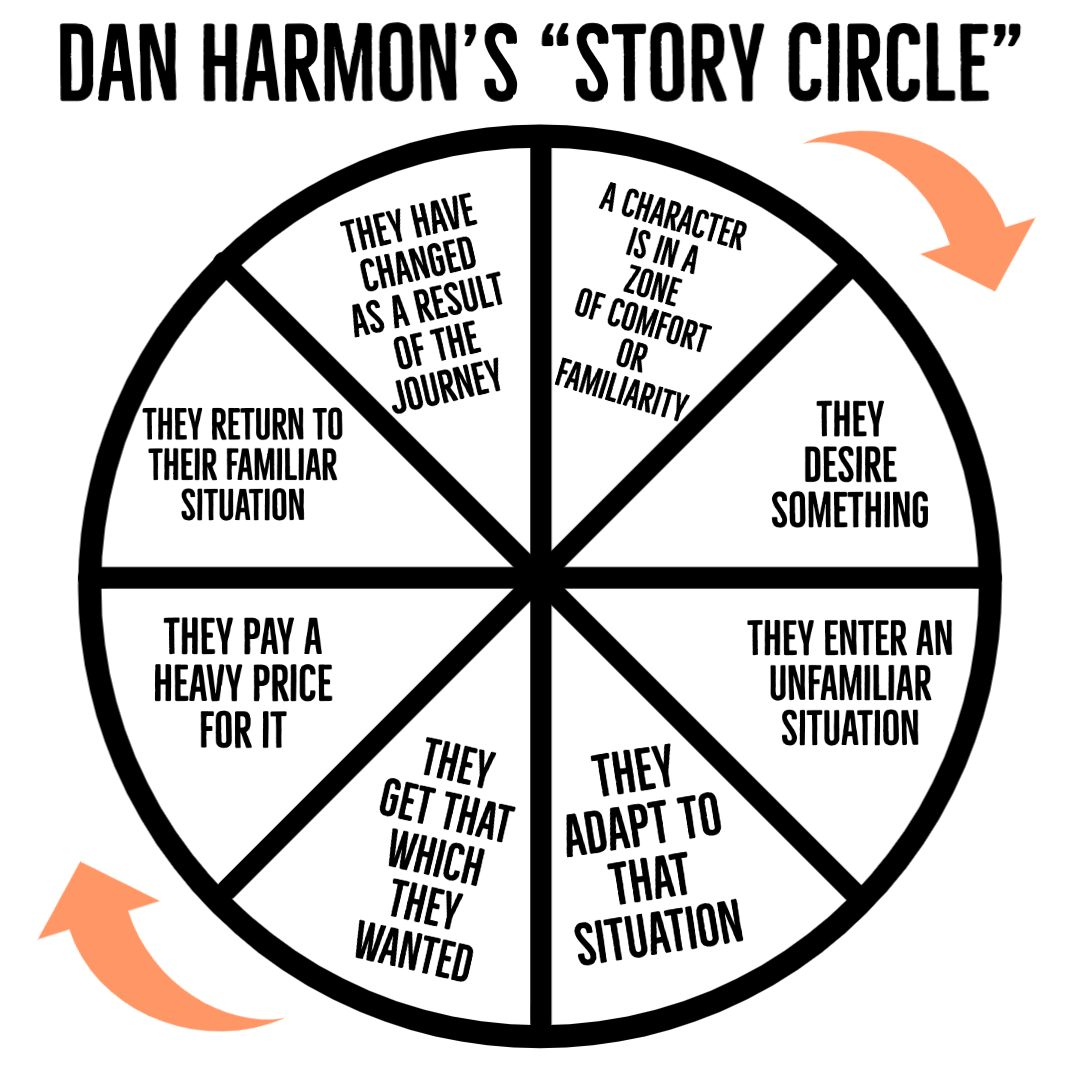
Similarly, the three and five act structures are cemented into the culture of writing courses across the Western world. There must and will always be an inciting incident. There must and will always be a ‘muddle in the middle’. And all stories must end. There are variations, with rising and falling action, the mid-point reversal, and lowest points peppered in, but the fundamentals are the same. Even Dan Harmon’s story circle is, in essence, a variation of this premise.
There’s a world in balance, a new and unfamiliar world to navigate, a cost to their desire, and a return home forever changed. The desire, the unfamiliar world, the cost, and the ‘home’ can and must vary from story to story, but the fundamental structure is the same. From Indianna Jones to Rick and Morty to The Odyssey, the bare bones are the same.
And despite nay-sayers and arthouse filmmakers arguing that there is no structure to storytelling, unfortunately for them there absolutely is, and there absolutely must be.
Why Structure is Important
I can’t remember where I heard it or if I made it up, but I often live by the rule that all stories without structure are just anecdotes. They meander without a point and, crucially, without an end. If audiences wanted stories that never ended, they’d be crying out to return to office working to hear Brenda and Clive talk about the holiday they went on where nothing happened, the food was fine, and they did or did not get the tan they were expecting.
Audiences don’t want to turn off because they got bored, they want to be told “that’s it, story’s done. What did you think?” Structure is a great way to give audiences that framework they subconsciously crave. And they all lived happily ever after…
The Seven Basic Plots, the story circle, the five act structure are all great frameworks for writers to use to ensure they don’t end up writing a 300 page tome where nothing happens, nobody changes, and nobody cares. You’re writing a quest? Great, that means you need a point A, a point Z, and a whole bunch of mini-adventures to get from one to the other. When you get to Z, the story ends. Nice.
You’re writing an episode of a TV series? Well then, crack out the five-act-structure and start plotting. In the Scriptnotes book, John August refers to the ‘Thing’ which an episode will be centred around, distinguishing it from other episodes. Take, for example, a police procedural. The ‘Thing’ would be the case of the week. That’s great, easy to apply a five act structure to the ‘Thing’.
But that ‘Thing’ gets to the heart of why the Scriptnotes podcast, and now myself, think that narrative structure is a bunch of poo.
Why we Should ALL Ignore Structure
When lecturers and authors cite the fact that narrative structure is as old as storytelling, they’re absolutely right. But, equally, Craig Mazin is right in the Scriptnotes book when he says that an obsession with structure will give you a well structured bad story.
All the structures give a sense of what is happening. Some even give lip-service to why things are happening. But the why is on the whole ignored by story structure, despite the why being what keeps audiences invested. The Wizard of Oz isn’t compelling because Oz is a magical place and Dorothy must go home because the structure demands it. The Wizard of Oz is compelling because “there’s no place like home.” From that simple, direct line, the whole story is extrapolated. From there, we know why the Wicked Witch must kidnap Dorothy, to take her far far away from home. With “no place like home” as the end point, writers know that, at the start of the film, Dorothy must want to run away. Why? So that her need to go home means something.
So many modern stories rely on stuff. Why does the world turn upside down at the end of page 10? Because the rules say so. Okay, but why? what does that mean for your protagonist(s)? Some stories can have this ‘inciting incident’ on page 01, others on page 15. If you’re looking at your story through the lens of why rather than what, then you’ll start to find that the what simply… happens. When Steve Rogers and Tony Stark argue on the Helicarier in The Avengers about making the ultimate sacrifice, audiences aren’t aware that the saga will end with Tony snapping his fingers to save the Universe and end his own life. That said, from looking backwards at the end of Avengers: Endgame, it could hardly have ended any other way.
Originally, Andor, the hit Star Wars show, was meant to be three seasons. In the end, we only got two, and they’re considered to be some of the best Star Wars stories in years. The reason? A strong why. From opportunistic nobody to hero of the rebellion, Cassian Andor had the why built into the fabric of his existence. His conflict stems from his need to reject his place in the rebellion but ultimately, when Mon Mothma gives her famous speech to the senate, he must stand up and take his inevitable place among the freedom fighters as a full believer. Chart the story backwards, it was all leading here, the what was simply the stuff on top of the why.
So, when writers say to ignore structure, what they’re really urging is that reliance is placed less on what happens and when, but why things happen and what that means. When seen through that lens, you may find that your story does naturally fit into the archetype of a Rebirth or the Story Circle, and that’s okay. In fact, it’s likely inevitable. Why? Because all those structure academics are right. Looking backwards, all stories do fit into neat little boxes.
But as writers, we aren’t looking backwards. We’re looking forwards. If we obsess over what’s written in textbooks, we’ll only ever write stale, textbook accurate stories. What we need to be looking forward at why we’re telling these stories. What are we saying that hasn’t been said before? If it has been said before, how is this saying it in a new way?
So, study structure. Get a Dan Harmon poster to put on your wall. But as soon as you start planning, writing, or devising your new project, tear it down and forget about it. Your writing, your audience, and your career will thank you for it.